Featured

Who I am

Young apprentice writer writings

“Man is not worried by real problems so much as by his imagined anxieties about real problems”

– Epictetus.

Hi! I hope you all are doing fine!

My name’s Axel, I’m an 18 year old young artist who is still trying to improve his skills as a singer and as a writer. I was born on December, 30th 2001 in Cali, Valle del Cauca. After my birth, my parents decided to move to Cartago, Valle del Cauca, so they could find a job eassily and start a new life there. When I was 8 years old, I told my parents I wanted a little brother, so they planned it and then my brother Joshua came to life on June 1st, 2009. Joshua is the smartest little kid I could ever met. I do not even know how, but he can understand English as if it were his native language. I consider we are not only a happy family but also a team, because we fight for our goals and we always help one another.

I’m such a dreamy boy. When I was a kid, I had this weird desire to be kidnapped by aliens, so they could give me extraordinary powers, which would help me stop famines and violence around the world. Yes, I know, it’s kinda funny and crazy. At the moment, I dream of being a great and well known artist. I would love to sing to lots of people on a big stage, I want to feel the adrenaline, emotion and conexion with everyone while sharing with them big parts of my heart and my soul through music.

I’m sure all of you know my name, my age, the things that I love and all that stuff. That’s why today I want to talk about all the things that are hidden inside my chest, things that maybe none of you know about. I want to do this because sometimes I feel like I’m choking on my own words and I don’t know who to talk to.

The person that you usually talk to at college during or outside classes, is a very different person when he’s alone at home or when he has plenty of free time on vacation. Maybe you don’t know, but sometimes I get lots of anxiety attacks and I just don’t know what to do to keep my mind quiet. When I get one of those attacks, I panicked and start breathing heavily without any control. Sometimes, I just want to sleep forever and never wake up. I also get a feeling of emptiness and loneliness. Then I start crying for no reason. I don’t know what to do when those thoughts get inside my head, but please, if you see me like that one day, remember that everything I need is a bit of company and a warm hug.

I’ve been through a lot since 2015, maybe all those problems that I had are the reason why I’m an anxious and eassily depressive person. I will tell you all about my past in the next entries…

Hope you all have a wonderful year!
Take care and drink water! ❤

Videogame’s benefits

Newzoo, the leading provider of market intelligence covering the global game, reported there were 2.67 billion gamers in the world at the end of 2019 (Louis, 2020). Besides, videogame branches reported increases in the number of players and copies sold of their flagship videogames such as “The Sims 4”, in which people can create a new virtual life, go to the university, manage to pay bills and get money, have a family, and form complex relationships; League of Legends, a competitive and cooperative strategy game, which motivates gamers to create well-structured strategies with their gaming groups to defeat their enemies; and “Minecraft”, the most famous survival, multiplayer, crafting videogame, takes all its players to unknown worlds, in which they have to collect natural resources, build refuges and survive as much as they can till they can manage to reach the end of the game. Taking this information into account, it is easy to notice videogames’ educative possibilities, content, and social influence in today’s society. However, many adults still believe videogames must be erased, arguing they are a waste of time and form violent and asocial habits in children and teenagers’ behavior. This negative one-sided perspective prevents adults to see how playing videogames is beneficial for society since it improves people’s cognitive and social skills.

To begin with, it has been proved that people who play videogames have better solving-problem skills. Due to videogames’ complex challenges, players must put into practice different strategies and ways to get out of different problems, which can leave their characters out of the resources they might need to survive or to keep going to the end of the game. As Granic et al (2014) said in their investigation about videogames and their benefits in people’s lives, “problem-solving seems central to all genres of video games (…) In-game puzzles range in complexity from finding the quickest route from A to B to discovering complex action sequences based on memorization and analytical skills” (p. 69). Indeed, videogames need a challenging factor to keep the players, not only engaged to the game, but to keep them thinking about the ways they can get out of a specific hard stage that puzzles their mind. On top of it, videogames commonly allow players to cooperate with their gaming group and, together, move forward the victory. As a result of all of the above, the perfect scenario is created to test and improve cognitive skills, while discovering new strategies for problem-solving, supported by the cooperative work of groups of players in the game.

           Furthermore, thanks to the challenging factor mentioned before, and the possibility to cooperate with others, gamers have created big gaming communities from all over the world. Nowadaysmost of the videogames offered are multiplayer, which allows gamers to be competitive within each other, to cooperate and unlock achievements, or to do both depending on the game. Thanks to the different situation players can be involved in through the games, they would rather have to decide how and with the support of whom they would fight someone in the game, or discuss with the others whether or not would be the right decision to keep the game going in the best way. These kinds of decisions are complex and lead them to develop important social skills, such as leadership, relationship management, verbal and written communication, and so, which can help them to distribute the different missions that fit better to everyone playing (Granic et al, 2014). As an illustration of all of this, the communities of gamers that Minecraft and League of Legends have created round over the 80 and 200 million players from all continents. This fact has made different videogame branches, such as Riot Games and Mojang, create big events and contests in which players and their gaming groups meet and play to win expensive prizes and global recognition in their respective gaming community. 

Notwithstanding, playing videogames uncontrollably can develop gaming disorders. The International Classification of Diseases 11th (2019) defined gaming disorders as a “pattern of gaming behavior characterized by a pattern of persistent or recurrent gaming behavior (‘digital gaming’ or ‘video-gaming’), which may be online (i.e., over the internet) or offline”. This metal disorder does not allow people to live normally because their time, concerns, and effort are focused only on videogames. Besides, they cannot control the amount of time they spend playing, which can lead to significant negative results in other aspects of their life, such as educational, work, and personal relations environments. However, this can be prevented if a controlled gaming schedule is set, and if the person schedules time to do healthy activities, such as working out, playing musical instruments, reading books, playing sports, and so on (WebMD Health Corporation, 2019). By doing this, people would not only take advantage of the benefits of video games, but could also find other entertainment alternatives that, in the same way, can be beneficial for their lives.

            Videogames are part of today’s’ society and there is nothing to do about it. Therefore, it is time for everyone to realize that both video games and new technologies can be beneficial. if people take advantage of these benefits and give a good usage of the things they are given, they will be able to develop important skills to survive in the contemporary world, such as the cognitive and social ones. Of course, as everything that exists in this world, excesses are wrong, and everyone must be concerned about the amount of time they expend doing something under no control. In the case of videogames, when someone starts concerning too much about them and does not care about the amount of time they spent playing, they are the ones that are not taking care of their mental health and personal life. Considering the above, it is time to ask people against videogames: are videogames responsible for peoples’ behavior, or people just give a wrong usage of them? 

Bibliography

Granic, I., Lobel, A., & Engels, R. C. M. E. (2014). The benefits of playing video games. American Psychologist, 69(1), 66–78. https://doi.org/10.1037/a0034857

Louis, A. (2020). Finances Online. Number of Gamers Worldwide 2020: Demographics, Statistics, and Predictions. Retrieved from https://financesonline.com/number-of-gamers-worldwide/

Minotti, M. (January 30, 2020, 1:30 PM). Games Beat Summit. The Sims 4 has reached 20 million players. Retrieved from: https://venturebeat.com/2020/01/30/the-sims-4-has-reached-20-million-players/

Heimer, R. (2019). How Many People Play League Of Legends [Blog post]. Retrieved from https://www.unrankedsmurfs.com/blog/players-2017.

Gilbert, B. (September 14, 2019, 8:20Am). Business Insider. ‘Minecraft’ has been quietly dominating for over 10 years, and now has 112 million players every month. Retrieved from https://www.businessinsider.com/minecraft-monthly-player-number-microsoft-2019-9

International Statistical Classification of Diseases and Related Health Problems (11th ed,; ICD-11; World Health Organization, 2019).

WebMD Health Corporation. (March 19, 2019). Video Game Addiction. Retrieved from https://www.webmd.com/mental-health/addiction/video-game-addiction#2
First draft – counter argument and conclusion: Videogames in society

Videogames in Society

Newzoo, the leading provider of market intelligence covering the global game, reported there were 2.67 billion gamers in the world at the end of 2019 (Louis, 2020). Besides, videogame branches reported increases in the number of players and copies sold of their flagship videogames such as “The Sims 4”, in which people can create a new virtual life, go to the university, manage to pay bills and get money, have a family, and form complex relationships; League of Legends, a competitive and cooperative strategy game, which motivates gamers to create well-structured strategies with their gaming groups to defeat their enemies; and “Minecraft”, the most famous survival, multiplayer, crafting videogame, takes all its players to unknown worlds, in which they have to collect natural resources, build refuges and survive as much as they can till they can manage to reach the end of the game. Taking this information into account, it is easy to notice videogames’ educative possibilities, content, and social influence in today’s society. However, many adults still believe videogames must be erased, arguing they are a waste of time and form violent and asocial habits in children and teenagers’ behavior. This negative one-sided perspective prevents adults to see how playing videogames is beneficial for society since it improves people’s cognitive and social skills.

To begin with, it has been proved that people who play videogames have better solving-problem skills. Due to videogames’ complex challenges, players must put into practice different strategies and ways to get out of different problems, which can leave their characters out of the resources they might need to survive or to keep going to the end of the game. As Granic et al (2014) said in their investigation about videogames and their benefits in people’s lives, “problem-solving seems central to all genres of video games (…) In-game puzzles range in complexity from finding the quickest route from A to B to discovering complex action sequences based on memorization and analytical skills” (p. 69). Indeed, videogames need a challenging factor to keep the players, not only engaged to the game but to keep them thinking about the ways they can get out of a specific hard stage that puzzles their mind. On top of it, videogames commonly allow players to cooperate with their gaming group and, together, move forward the victory. As a result of all of the above, the perfect scenario is created to test and improve cognitive skills, while discovering new strategies for problem-solving, supported by the cooperative work of groups of players in the game.

           Furthermore, thanks to the challenging factor mentioned before, and the possibility to cooperate with others, gamers have created big gaming communities from all over the world. Nowadaysmost of the videogames offered are multiplayer, which allows gamers to be competitive within each other, to cooperate and unlock achievements, or to do both depending on the game. Thanks to the different situation players can be involved in through the games, they would rather have to decide how and with the support of whom they would fight someone in the game, or discuss with the others whether or not would be the right decision to keep the game going in the best way. These kinds of decisions are complex and lead them to develop important social skills, such as leadership, relationship management, verbal and written communication, and so, which can help them to distribute the different missions that fit better to everyone playing. As an illustration of all of this, the communities of gamers that Minecraft and League of Legends have created round over the 80 and 200 million players from all continents. This fact has made different videogame branches, such as Riot Games and Mojang, create big events and contests in which players and their gaming groups meet and play to win expensive prizes and global recognition in their respective gaming community. 

Notwithstanding, playing videogames uncontrollably can develop gaming disorders. The international classification of diseases 11th (2019) defined gaming disorders as a “pattern of gaming behavior characterized by a pattern of persistent or recurrent gaming behavior (‘digital gaming’ or ‘video-gaming’), which may be online (i.e., over the internet) or offline”. This metal disorder does not allow people to live normally because their time, concerns, and effort are focused only on videogames. Besides, they cannot control the amount of time they spend playing, which can lead to significant negative results in other aspects of their life, such as educational, work, and personal relations environments. However, this can be avoided if a controlled gaming schedule is set, and if the person schedules time to do healthy activities, such as working out, playing musical instruments, reading books, playing sports, and so on. By doing this, people would not only take advantage of the benefits of video games, but could also find other entertainment alternatives that, in the same way, can be beneficial for their lives.

            Videogames are part of today’s’ society and there is nothing to do about it. Therefore, it is time for everyone to realize that both video games and new technologies can be beneficial for everyone. if people take advantage of these benefits and give a good usage of the things they are given, they will be able to develop important skills to survive in the modern world, such as the cognitive and social ones. Of course, as everything that exists in this world, excesses are wrong, and everyone must be concerned about the amount of time they expend doing something under no control. In the case of videogames, when someone starts concerning too much about them and does not care about the amount of time they spent playing, they are the ones that are not taking care of their mental health and personal life. Considering the above, it is time to ask people against videogames: are videogames responsible for peoples’ behavior, or people just give a wrong usage of them? 

FINAL DRAFT – TWO BODYPARAGRAPHS: VIDEOGAMES AND SOCIETY

Newzoo, the leading provider of market intelligence covering the global game, reported there were 2.67 billion gamers in the world at the end of 2019 (Louis, 2020). Besides, videogame branches reported increases in the number of players and copies sold of their flagship videogames such as “The Sims 4”, in which people can create a new virtual life, go to the university, manage to pay bills and get money, have a family, and form complex relationships; League of Legends, a competitive and cooperative strategy game, which motivates gamers to create well-structured strategies with their gaming groups to defeat their enemies; and “Minecraft”, the most famous survival, multiplayer, crafting videogame, takes all its players to unknown worlds, in which they have to collect natural resources, build refuges and survive as much as they can till they can manage to reach the end of the game. Taking this information into account, it is easy to notice videogames’ educative possibilities, content, and social influence in today’s society. However, many adults still believe videogames must be erased, arguing they are a waste of time and form violent and asocial habits in children and teenagers’ behavior. This negative one-sided perspective prevents adults to see how playing videogames is beneficial for society since it improves people’s cognitive and social skills.

To begin with, it has been proved that people who play videogames have better solving-problem skills. Due to videogames’ complex challenges, players must put into practice different strategies and ways to get out of different problems, which can leave their characters out of the resources they might need to survive or to keep going to the end of the game. As Granic et al (2014) said in their investigation about videogames and their benefits in people’s lives, “problem-solving seems central to all genres of video games (…) In-game puzzles range in complexity from finding the quickest route from A to B to discovering complex action sequences based on memorization and analytical skills” (p. 69). Indeed, videogames need a challenging factor to keep the players, not only engaged to the game but to keep them thinking about the ways they can get out of a specific hard stage that puzzles their mind. On top of it, videogames commonly allow players to cooperate with their gaming group and, together, move forward the victory. As a result of all of the above, the perfect scenario is created to test and improve cognitive skills, while discovering new strategies for problem-solving, supported by the cooperative work of groups of players in the game.

           Furthermore, thanks to the challenging factor mentioned before, and the possibility to cooperate with others, gamers have created big gaming communities from all over the world. Nowadaysmost of the videogames offered are multiplayer, which allows gamers to be competitive within each other, to cooperate and unlock achievements, or to do both depending on the game. Thanks to the different situation players can be involved in through the games, they would rather have to decide how and with the support of whom they would fight someone in the game, or discuss with the others whether or not would be the right decision to keep the game going in the best way. These kinds of decisions are complex and lead them to develop important social skills, such as leadership, relationship management, verbal and written communication, and so, which can help them to distribute the different missions that fit better to everyone playing. As an illustration of all of this, the communities of gamers that Minecraft and League of Legends have created round over the 80 and 200 million players from all continents. This fact has made different videogame branches, such as Riot Games and Mojang, create big events and contests in which players and their gaming groups meet and play to win expensive prizes and global recognition in their respective gaming community. 

Bibliography

Granic, I., Lobel, A., & Engels, R. C. M. E. (2014). The benefits of playing video games. American Psychologist, 69(1), 66–78. https://doi.org/10.1037/a0034857

Louis, A. (2020). Finances Online. Number of Gamers Worldwide 2020: Demographics, Statistics, and Predictions. Retrieved from https://financesonline.com/number-of-gamers-worldwide/

Minotti, M. (January 30, 2020, 1:30 PM). Games Beat Summit. The Sims 4 has reached 20 million players. Retrieved from: https://venturebeat.com/2020/01/30/the-sims-4-has-reached-20-million-players/

Heimer, R. (2019). How Many People Play League Of Legends [Blog post]. Retrieved from https://www.unrankedsmurfs.com/blog/players-2017.

Gilbert, B. (September 14, 2019, 8:20Am). Business Insider. ‘Minecraft’ has been quietly dominating for over 10 years, and now has 112 million players every month. Retrieved from https://www.businessinsider.com/minecraft-monthly-player-number-microsoft-2019-9

FIRST DRAFT – BODY PARAGRAPHS: VIDEOGAMES AND SOCIETY

Newzoo, the leading provider of market intelligence covering the global game, reported there were 2.67 billion gamers in the world at the end of 2019 (Louis, 2020). Besides, videogame branches reported increases in the number of players and copies sold of their flagship videogames such as “The Sims 4”, in which people can create a new virtual life, go to the university, manage to pay bills and get money, have a family, and form complex relationships; League of Legends, a competitive and cooperative strategy game, which motivates gamers to create well-structured strategies with their gaming groups to defeat their enemies; and “Minecraft”, the most famous survival, multiplayer, crafting videogame, takes all its players to unknown worlds, in which they have to collect natural resources, build refuges and survive as much as they can till they can manage to reach the end of the game. Taking this information into account, it is easy to notice videogames’ educative possibilities, content, and social influence in today’s society. However, many adults still believe videogames must be erased, arguing they are a waste of time and form violent and asocial habits in children and teenagers’ behavior. This negative one-sided perspective prevents adults to see how playing videogames is beneficial for society since it improves people’s cognitive and social skills.

To begin with, it has been proved that people who play videogames have better solving-problem skills. Due to videogames’ complex challenges, players must put into practice different strategies and ways to get out of different problems, which can leave their characters out of the resources they might need to survive or to keep going to the end of the game. As Granic et al (2014) said in their investigation about videogames and their benefits in people’s lives “problem-solving seems central to all genres of video games (…) In-game puzzles range in complexity from finding the quickest route from A to B to discovering complex action sequences based on memorization and analytical skills” (p. 69). Indeed, videogames need a challenging factor to keep the players, not only engaged to the game but to keep them thinking about the ways they can get out of a specific hard stage that puzzles their mind, also allowing them to cooperate with their gaming group and move together forward the victory, which creates the perfect scenario to share and improve solving-problem strategies.

           Furthermore, thanks to the challenging factor mentioned before, and the possibility to cooperate with others, gamers have created big gaming communities from all over the world. Nowadaysmost of the videogames offered are multiplayer, which allows gamers to be competitive within each other, to cooperate and unlock achievements, or to do both depending on the game. Thanks to the different situation players can be involved in through the games, they would rather have to decide how and with the support of whom they would fight someone in the game, or discuss with the others whether or not would be the right decision to keep the game going in the best way. These kinds of decisions are complex and lead them to develop important social skills, such as leadership, relationship management, verbal and written communication, and so, which can help them to distribute the different missions that fit better to everyone playing. As an illustration of all of this, the communities of gamers that Minecraft and League of Legends have created round over the 80 and 200 million players from all continents. This fact has made different videogame branches, such as Riot Games and Mojang (the companies that own the games named before), create big events and contests in which players with their gaming groups meet and play to win expensive prizes and global recognition in their respective gaming community. 

FIRST DRAFT: Videogames’ benefits

This is the first draft of my argumentative text introduction.

Newzoo, the leading provider of market intelligence covering the global game, reported there were 2.67 billion gamers in the world at the end of 2019. Besides, some videogames branches reported the number of players and copies sold of their flagship videogames: Electronic Arts’ game “The Sims 4”, in which you can create a new virtual life, go to the university, have a family, get a job and form complex relationships, has reached 20 million unique players worldwide; League of Legends, a competitive, cooperative, strategy videogame, in which you have to defeat your enemies, have given Riot Games an active player base of over 80 million monthly players; “Minecraft”, Mojang’s survival, multiplayer, crafting videogame, created one of the biggest communities in gaming with 112 people playing every month. Taking this information into account, it is easy to notice video games ’influence in today’s society. However, many adults believe videogames are bad for people, arguing they are violent and useless for children and teenager’s lives, but this one-sided negative perspective prevents them to see how videogames are beneficial for society in cognitive, emotional and social aspects.

Brainstorming!

Outline:

  • Background information
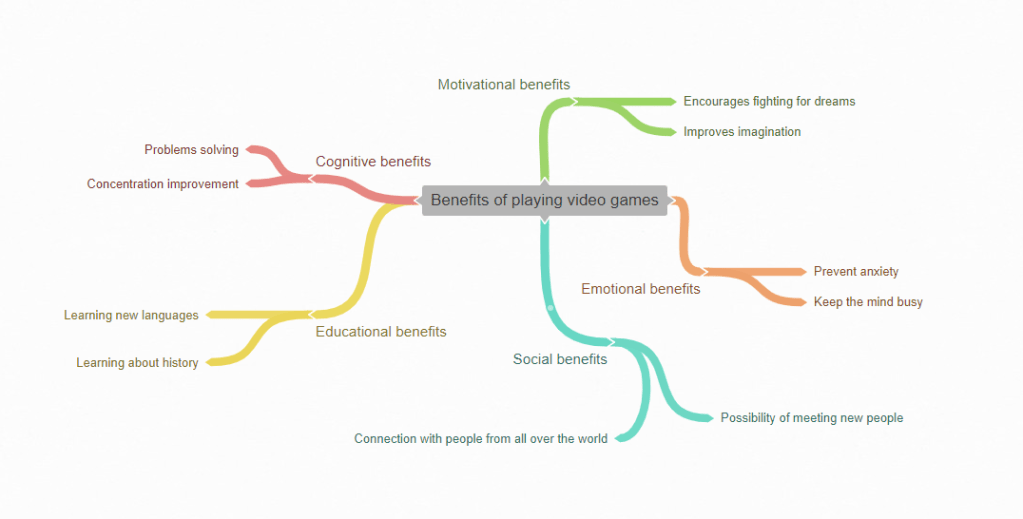
    • Nowadays, many adults believe videogames are bad for people, arguing they are violent and useless for children and teenager’s lifes, but this is only one sided negative perspective of what videogames are.
  • Claim
    • Videogames are beneficial for society
  • Motives:
    • Cognitive benefits
    • Emotional  benefits
    • Social benefits

PROCESS TO CREATE THE THESIS:
Step #1 – Think of a broad subject and then narrow that subject into a more specific topic. Example – I want to write about the subject of what skills a college student learns in college, and I want to focus on the skill of writing (topic).

  • I want to talk about videogames and focus on thier benefits in people’s life

Step #2 – Once the topic has been established, create a specific question that relates to the topic: Why is it important that college students learn how to write well?

Q: Why are videogames good for people?

Step #3 – Now, create an answer to the question above: Because writing is a skill that is required in most classes, college students need to learn how to write well in order to succeed academically. This answer becomes a potential working thesis statement for an essay. 

A: Because videogames give people cognitive, emotional and social benefits.

THIRD DERBY WRITING: Earth Song – Michael Jackson

Curiously, we all have gotten to this point. I think we are ready to see how the world environment can change for good if we change our lifestyles. Coronavirus is an awful sickness, but this pandemic was necessary to show us the importance of taking care of our nature. Now we can see the skies clearer, now we can breathe better, now the animals can be free and, because we did not hear the warnings before, we have to stay in our home-prison for a long time…

FINAL DRAFT: The importance of hard work over talent.

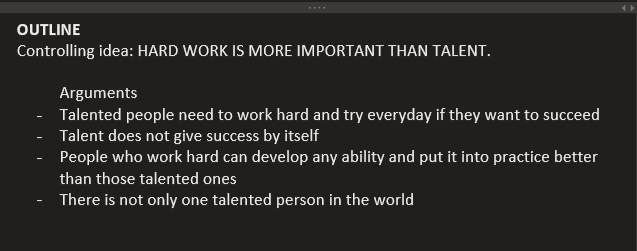
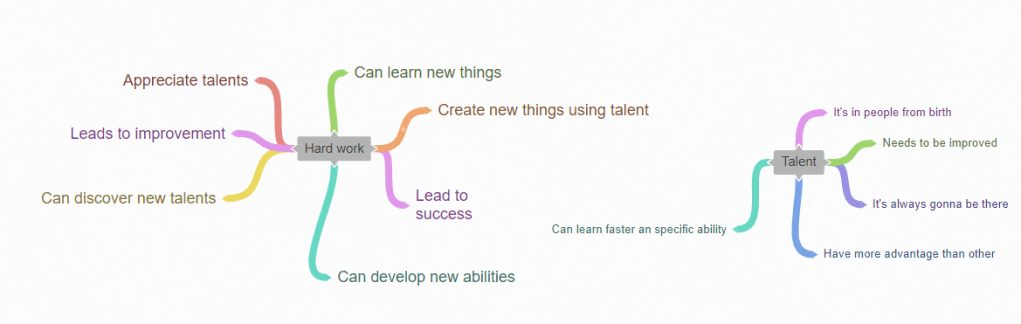
One of the common things one can hear about talent is that it will never get over hard work, but, to me, hard work is more important since it leads people to achieve their objectives and to improve their skills. Even though hard work is very important, many people think that just because they are talented they do not need to keep working, which leads them to stop worrying about improving their natural abilities. Eventually, those gifted ones will stay the same while other talented or not talented at all people might be improving their abilities to succeed and be better every day. This shows how not working hard is a waste of talent, as it does not bring those skills to their maximum splendor. Moreover, this smug behavior can make lose those unique capacities. That is why, at some point in their lives, they could find themselves behind the ones that might not be very talented, but are fighting to succeed. Of course, this is not about competing within each other, but to be grateful for the things we can do and try to do them as better as possible.

Second Derby Writing: A letter to the 6 year-old me

Happy little me, could you teach me how to live? You always seemed to be enjoying everything you had and did, no matter how hard life situations were.

Naïve little me, wish I could be strong like you. Your smile and joy were untouchable. When did everything change? When did I loose you?

If there’s something I could tell you, it’d be to take care of yourself too. Please, for God’s sake, don’t let anyone do what they want to you. Love yourself and don’t let anyone hurt you.

Also, remember how important and valuable you are for the ones you love and love you.

I’m really missing you… take care

First Draft of a Short Paragraph: Hard Work and Talent.

Hard work is more important than talent because it leads people to achieve their objectives and to improve their skills. Even though hard work is very important, many talented people think that just because they are talented they do not need to keep working, and that belief leads them to stop worrying about improving their talents. Eventually, that people and their talents will stay the same while more other talented or not talented people might be improving their abilities to succeed and be better every day. Therefore, people who do not work hard to improve their abilities are wasting their talents and that is why, at some point in their lives, they could find themselves behind the ones that might not be very talented, but are fighting to succeed.

Little BrainStorming:

Little Outline:

My own description

(From the perspective of my parents)

There he is as usual inside his bedroom, sitting on the cornor of his bed. He’s got plenty of bravery to do as he want to do without thinking of the risks, but, even though he seems unstoppable, he’s always weeping for unknown reasons.

“Where are his friends?” We ask to ourselves everytime we see him looking through the window as if he were waiting for someone who never appears.

When he gets tired of gazing outside, he prepares his tutorials to help the students of his school in a deeply melancholic manner.
“What could we do,? What is happening to him?” We both wonder without an explanation.

He’s a nice person, but it seems that nobody is noticing how good friend he could be. As his parents, we know he could be capable of giving his life to save the ones he loves…

Design a site like this with WordPress.com
Get started